

1887 Football Team
Year
1887
Sport
Football
Decade
1800s
Three wins, three losses and one tie hardly sounds like a "great" team in the long tradition of Trinity football, but the 1887 football team was groundbreaking in many ways. As Robert Morris '16 wrote in his history of Trinity football, Pigskin Parade, "It was during 1887 that Trinity football came of age."
When Billy Barber '88 and Joe Shannon '87 arrived as freshmen in 1883 (Barber took a year off to help his family), they were shocked to find football had gone on hiatus at the college. They quickly restarted the program, although the next three years (1884, 1885 and 1886) were rebuilding years, and they failed to win a single game.
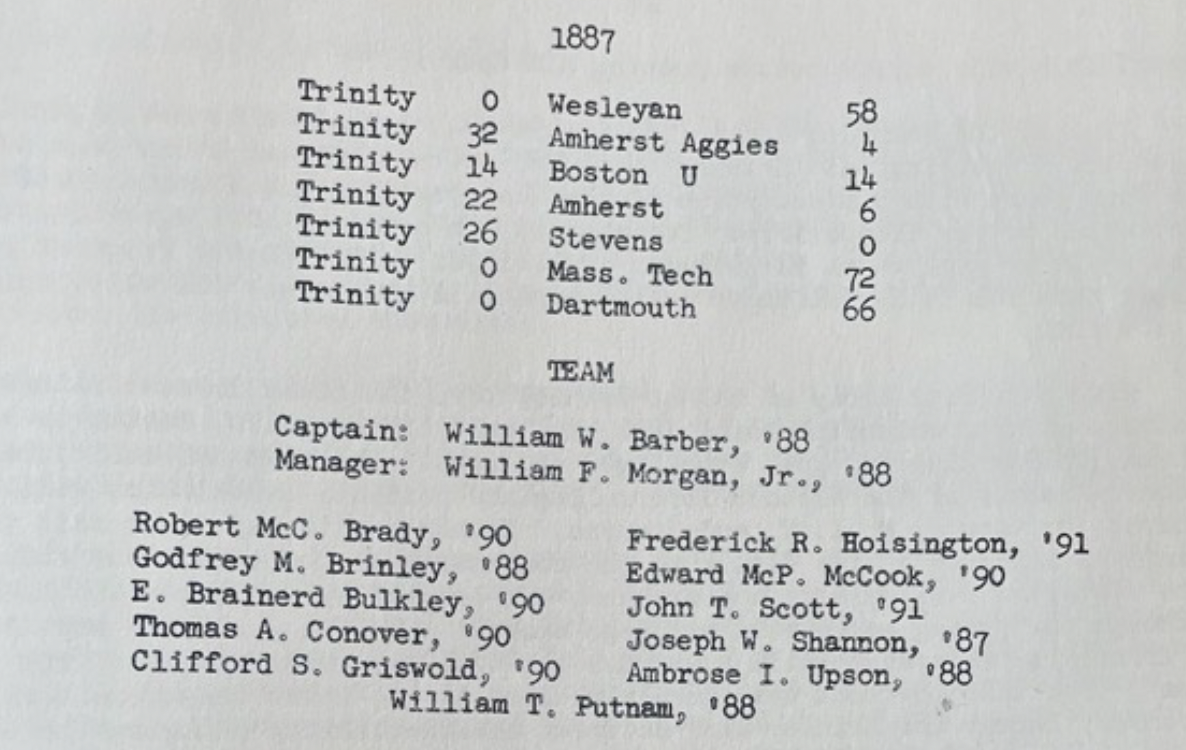
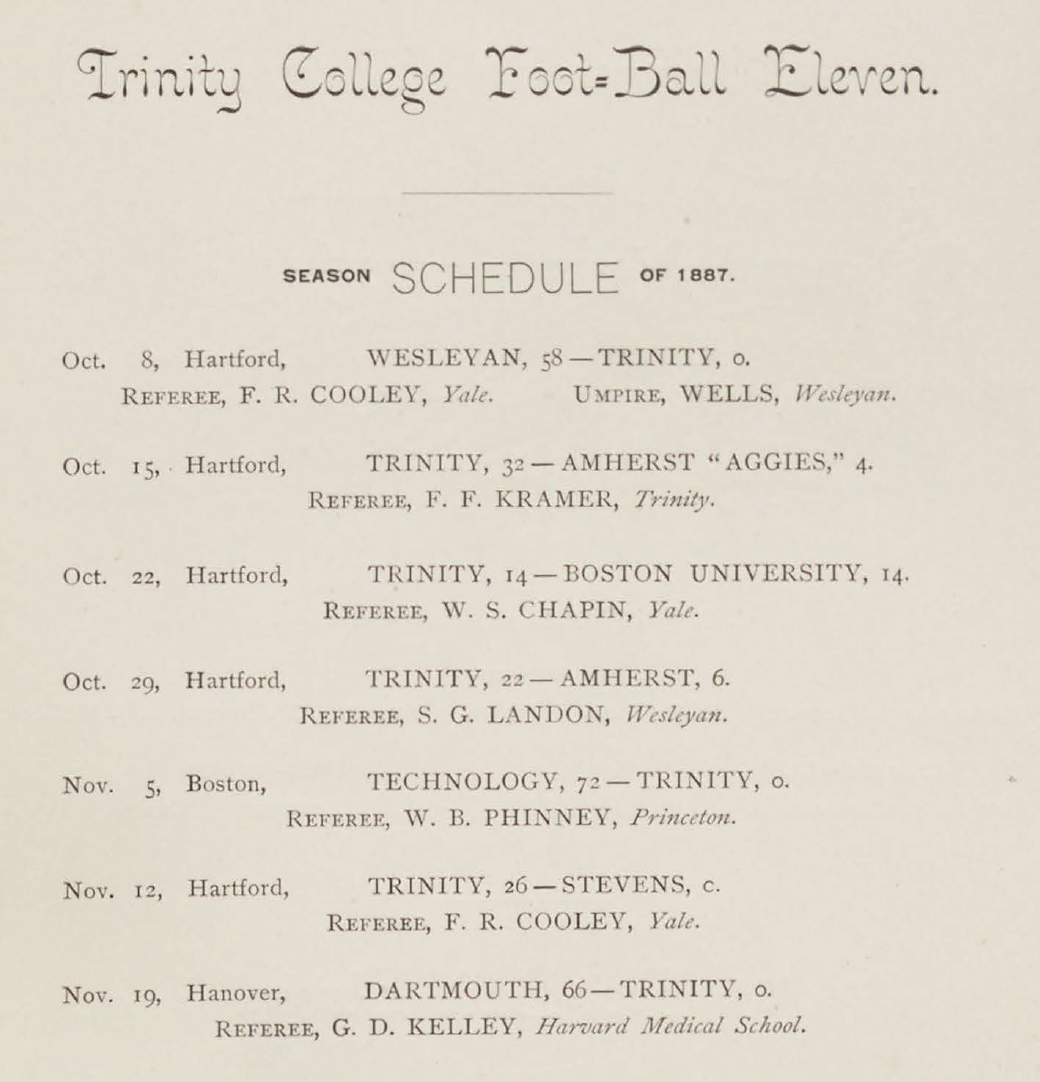
But 1887 was a breakout year. They beat the Amherst "Aggies" 32-4 (Not Amherst College but what became the University of Massachusetts at Amherst), which constituted the first football victory for the college. They went on to beat the other team in Amherst, Mass, Amherst College and Stevens, tied Boston University, but lost handily to Wesleyan, Dartmouth and MIT.
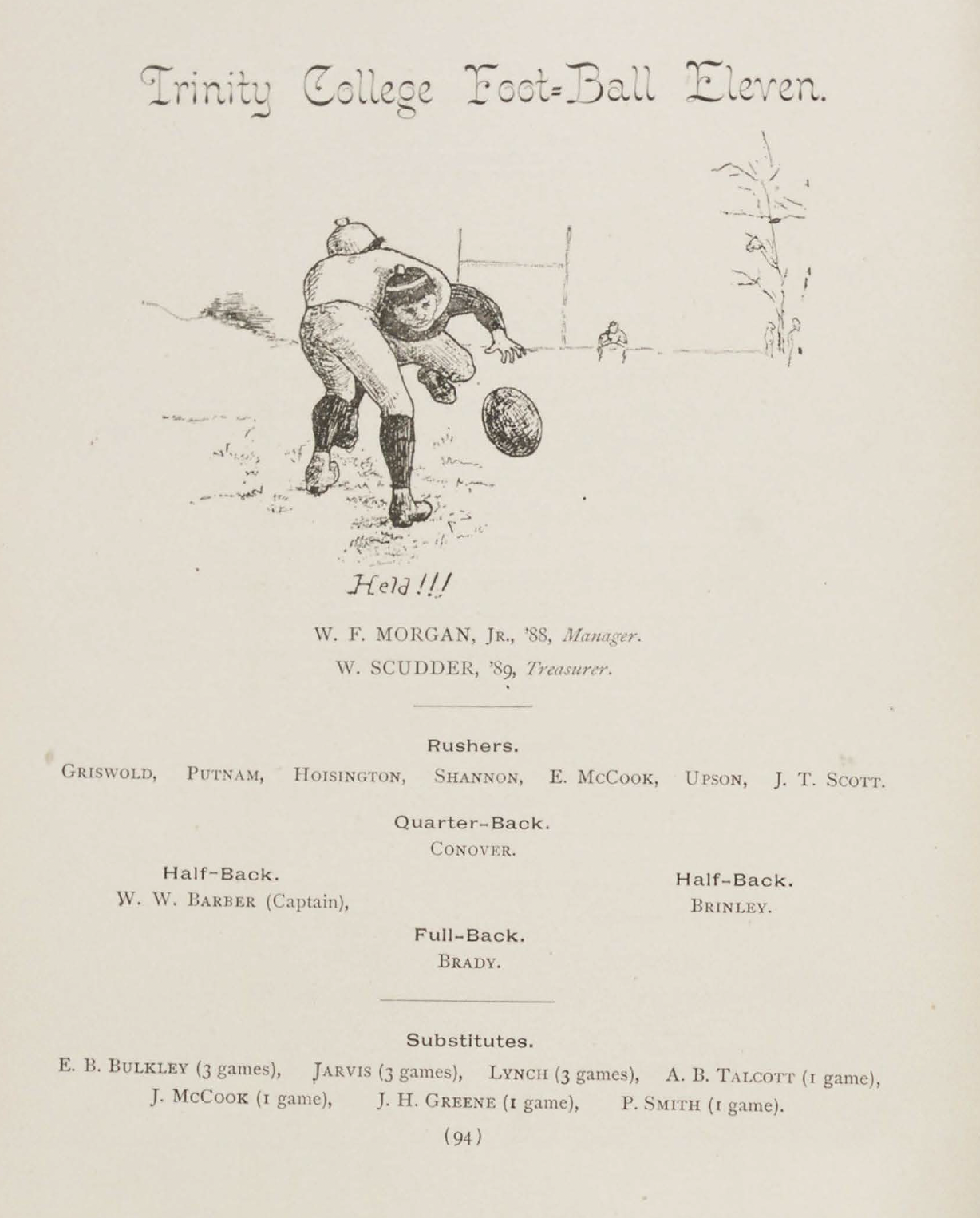
Still, the team, led by Barber at captain (the only three time captain in Trinity football history) had a "galaxy of stars," according to Morris, including Billy Barber's running mate, Godfrey Brinley '88, his battery mate on the Trinity baseball team, Joe Shannon '87 (who was allowed to play while a graduate student at Trinity), along with younger classmates Ed McCook '90, Mac Brady '90 and E. Brainerd Bulkeley '90. "Brady's 150 pounds would have been considered inadequate in most camps for the heavy assignment of line blocking," wrote Morris, "but his heritage from 'fighting Irish' ancestry offset this handicap. Bulkeley, for his part, was so good, according to Morris, that Yale tried to induce him to transfer. He stayed at Trinity.
That year, Trinity joined the Eastern Intercollegiate Football Association with Amherst, Dartmouth, MIT and Stevens. Its victories over Amherst and Stevens garnered it a third place finish in the new conference but as a testament to Trinity talent, Barber and Brinley received the distinction of being voted the best backs in the association.
Indeed, after its founding a decade earlier in 1877, and after many fits and starts, Trinity football had indeed come of age.


