

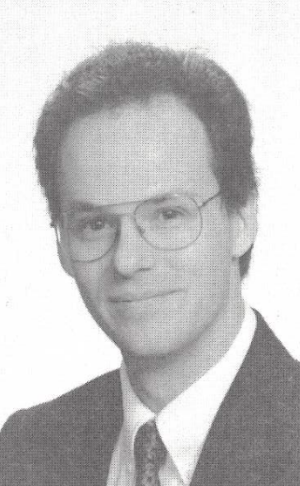
Timothy B. Spahr
Class
1997
Graduation
1988
Building on a childhood interest in comets and astronomy, Timothy B. Spahr has received international recognition for his role in the discovery of a large near-earth asteroid (1996 JA1) and Comet 1996 R1 (Hergenrother-Spahr). Born in Xenia, Ohio, Spahr grew up in Fairborn, attended the Fairborn City Schools for 12 years, and graduated from Fairborn High School in 1988. During his high school years, he was a member of the baseball and football teams, band, Spanish Club, and Top Scholars.
An excellent scholar, Spahr graduated from the University of Arizona receiving his Bachelor of Science degree in physics and astronomy in 1992. He received a Master of Science degree from the University of Florida in 1995. Spahr is currently pursuing a Ph.D. in astronomy at the University of Florida where he has been awarded the Florida Space Grant Consortium Fellowship to complete his thesis.
He served as a research assistant at the University of Arizona in the Department of Planetary Science, at the University of Florida in the Department of Astronomy, and at the Harvard-Smithsonian Center for Astrophysics and Planetary Science.
Spahr has had several stints as a teaching assistant in the astronomy departments at the University of Florida and the University of Arizona. At the latter, he served as the operator of the university’s 21-inch reflector and as director of the campus telescope facility. He was an intern and a volunteer at the Lowell Observatory in the summer of 1995.
There are approximately 10,000 astronomers in the world, but only about 30 work in the field of near-earth objects. This is the field Spahr, age 26, has concentrated on, and he has found remarkable success. Using a relatively low-technology procedure, Spahr and his research partner, Carl Hergenrother (age 23), discovered an asteroid making a near approach to Earth in May 1996. The asteroid, named “1996JA1,” was estimated to be nearly one-third of a mile in diameter, was traveling in excess of 10 miles per second, and would approach within 279,000 miles of the Earth. While that approach is still farther away than the moon, it is a mere hair’s breadth in astronomical terms. It is the largest known object to approach that close to the Earth since the collection of astronomical data on asteroids began in the 1930s. There have been five approaches closer to Earth but none of this size.
It is estimated that an asteroid the size of 1996 JA1 and traveling at a similar speed would not destroy life on Earth or cause as much damage as the asteroid believed to have wiped out the dinosaurs 65 million years ago. Such an impact could leave a crater two to three miles in diameter and have an explosive force 150 times larger than the Hiroshima atom bomb. If a comparable impact occurred in the ocean, tidal waves 200 feet high could be generated.
Spahr’s discovery was confirmed by the International Astronomical Union at Harvard University and also verified by astronomers from around the world. Over 100 near-earth objects large enough to cause worldwide disasters have been identified and charted, but there are an estimated 2,000 more of similar size that are undetected and hundreds of thousands of smaller objects in the Earth’s neighborhood. The work of Spahr and Hergenrother may give impetus to additional study to identify these large objects which may impact Earth.
The team of Hergenrother-Spahr has also been credited by the American Astronomical Society with the discovery of Comet 1996 R1 in September of 1996, and it now bears their names. Prior to this discovery, Asteroid 2975 was named “Spahr” by his colleagues at the Harvard-Smithsonian Center for Astrophysics and Astronomy. The impressive work by Spahr this early in his career brings to light the need for funding for the study of near-earth objects for their potential to create disasters on Earth.
Spahr has made presentations to a number of astronomical society symposia in this country and in France, on mainbelt asteroid orbital elements, asteroid and comet surveying, asteroid and comet search and activity levels of comets. He has authored eight publications on his research and discoveries and has received the Douglas Scholarship at the University of Arizona and a film grant from Eastman Kodak’s Scientific Imaging Division. He is a member of the American Astronomical Society, Division for Planetary Science.
Spahr’s attention to an area of astronomical research which receives little attention from most astronomers has generated scientific interest around the world. Using a relatively low-technology approach and a diligence to work with great care has obviously reaped recognition for this young astronomer.
Spahr lives in Florida where he is finishing his doctoral work, and he commutes to Arizona as time and circumstances dictate.


